Home batteries
 Commercial energy storage
 EV chargers
 Installation
Complete systems
What is a complete system?
With a complete system, everything the storage needs is already inside one cabinet: the battery modules, the cooling, the control and the protection. You order one item instead of separate parts that need to match. For most businesses that works better, because most mistakes in this segment come from combining capacity and power that do not fit together.
When is this not the right choice?
If you already have an inverter you want to reuse, or you already know you want to expand in two years, separate modules and your own inverter give you more flexibility. A complete cabinet is a closed unit: scaling up means a second cabinet, not an extra module. That is the trade-off, and it depends purely on your plans.
Capacity or power?
Those two are the most commonly confused. Capacity in kWh tells you how much energy fits in, power in kW tells you how fast it can go in and out. For peak shaving, power matters most: you want to shave off a short, high peak, and a system with modest capacity can do that fine. If you want to use daytime solar power in the evening, capacity is what counts. Two businesses with the same annual consumption can therefore need completely different systems.
| Goal | What you need | What to check |
|---|---|---|
| Lower contracted power | high power, moderate capacity | how long your peaks last |
| Shift solar power | ample capacity | how much you have left over per day |
| Both | power and capacity in proportion | the system's C-rate |
What to watch out for
The setup. These cabinets weigh hundreds of kilos and need a flat, load-bearing surface and a delivery route wide enough. With liquid-cooled systems, the cooling circuit belongs in a maintenance contract, so factor that into your running costs, not just the purchase price. And allow for the lead time at your grid operator, which in practice determines the completion date more often than the system's delivery time.
What we take care of
We work through your consumption data, put the system together and deliver it complete. We deliberately do not install it ourselves, see commercial storage installation. Prices here run through a tailored quote, because grid connection and peak pattern vary too much per business for a fixed price list.
Frequently asked questions
Can I expand a complete system later?
Not within the cabinet. Expanding means a second system alongside it. If you expect growth, tell us in advance and we can account for that in the design.
How much space do I need?
That is listed per model on the product page. Besides the cabinet itself, allow free space for maintenance and a route wide enough for a pallet.
Does such a system work as backup power?
Only with the right switching added, and that is a design choice you make in advance. Mention it in your request, adding it afterwards is more expensive.
What does it cost?
That depends on capacity, power and your grid connection. We deliberately do not give a fixed range, since it would not be accurate for most situations.
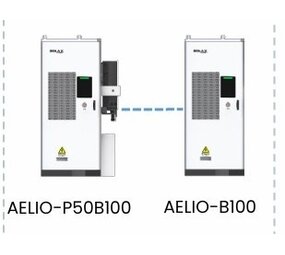
De AELIO-50K omvormer met de B100-...
De AELIO-50K omvormer m...
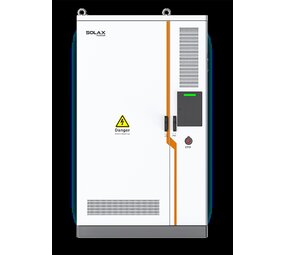
Compleet zakelijk opslagsysteem va...
Compleet zakelijk opsla...
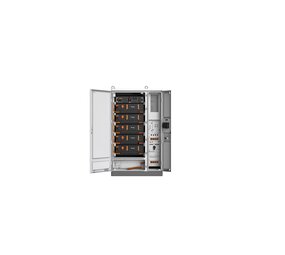
Vloeistofgekoeld opslagsysteem van...
Vloeistofgekoeld opslag...
- Erkende installatie mogelijk
- Merkonafhankelijk advies
- Scherpe outletprijzen
Overige categorieën in Commercial energy storage
Complete systems
What is a complete system?
With a complete system, everything the storage needs is already inside one cabinet: the battery modules, the cooling, the control and the protection. You order one item instead of separate parts that need to match. For most businesses that works better, because most mistakes in this segment come from combining capacity and power that do not fit together.
When is this not the right choice?
If you already have an inverter you want to reuse, or you already know you want to expand in two years, separate modules and your own inverter give you more flexibility. A complete cabinet is a closed unit: scaling up means a second cabinet, not an extra module. That is the trade-off, and it depends purely on your plans.
Capacity or power?
Those two are the most commonly confused. Capacity in kWh tells you how much energy fits in, power in kW tells you how fast it can go in and out. For peak shaving, power matters most: you want to shave off a short, high peak, and a system with modest capacity can do that fine. If you want to use daytime solar power in the evening, capacity is what counts. Two businesses with the same annual consumption can therefore need completely different systems.
| Goal | What you need | What to check |
|---|---|---|
| Lower contracted power | high power, moderate capacity | how long your peaks last |
| Shift solar power | ample capacity | how much you have left over per day |
| Both | power and capacity in proportion | the system's C-rate |
What to watch out for
The setup. These cabinets weigh hundreds of kilos and need a flat, load-bearing surface and a delivery route wide enough. With liquid-cooled systems, the cooling circuit belongs in a maintenance contract, so factor that into your running costs, not just the purchase price. And allow for the lead time at your grid operator, which in practice determines the completion date more often than the system's delivery time.
What we take care of
We work through your consumption data, put the system together and deliver it complete. We deliberately do not install it ourselves, see commercial storage installation. Prices here run through a tailored quote, because grid connection and peak pattern vary too much per business for a fixed price list.
Frequently asked questions
Can I expand a complete system later?
Not within the cabinet. Expanding means a second system alongside it. If you expect growth, tell us in advance and we can account for that in the design.
How much space do I need?
That is listed per model on the product page. Besides the cabinet itself, allow free space for maintenance and a route wide enough for a pallet.
Does such a system work as backup power?
Only with the right switching added, and that is a design choice you make in advance. Mention it in your request, adding it afterwards is more expensive.
What does it cost?
That depends on capacity, power and your grid connection. We deliberately do not give a fixed range, since it would not be accurate for most situations.